what event was the palace of versailless hall of mirrors designed to celebrate?
Palace of Versailles: Facts & History
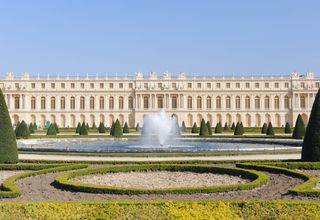
The Palace of Versailles is an opulent complex and former majestic residence outside of Paris. It has held sway in the public imagination for years because of its architectural grandeur and political history.
"To the public imagination, Versailles is the epitome of opulence," said Louise Boisen Schmidt, a Denmark-based writer at This Is Versailles. "It represents an age in French history of both French republic'southward rising as a fashion and ability center as well as the dramatic — and bloody — decline of the monarchy."
Located about x miles (16 kilometers) southwest of Paris, the palace is beside the settlement of Versailles. The town was niggling more than a hamlet earlier becoming the seat of royal ability. Past the time of the French Revolution, it had a population of more than 60,000 people, making it one of the largest urban centers in France.
From hunting lodge to palace
France's kings were commencement attracted to Versailles because of the area's prolific game. Louis XIII, who lived 1601-1643, bought upwards land, built a chateau and went on hunting trips. At the fourth dimension, much of the land effectually Versailles was uncultivated, assuasive wild fauna to flourish.
The chateau Louis XIII built was little more than a hunting lodge having enough space to house the king and a pocket-sized entourage. Information technology was his successor, Louis Fourteen (1638-1715), the "Sunday Rex," a ruler who chose the dominicus as his emblem and believed in centralized government with the king at its centre, who would radically transform Versailles making it the seat of France's government by the time of his death.
Louis Fourteen ruled French republic for 72 years, and in that fourth dimension transformed Versailles by encompassing Louis XIII'due south chateau with a palace that contained n and due south wings, as well as nearby buildings housing ministries.
Versailles was congenital to impress. "The nigh important bulletin Louis Fourteen sent through the architecture of Versailles was his ultimate ability," said Tea Gudek Snajdar, an Amsterdam-based art historian, museum docent and a blogger at Civilisation Tourist. "He is an absolute monarch, untouchable and distant. But, even more so that, he is the Sunday King. That symbolism of the Sun King is very visible in the architecture of the Versailles. The painter Lebrun, who designed the iconographic program of the Palace, focused paintings, sculptures and the architecture to one goal only — celebrating the King."
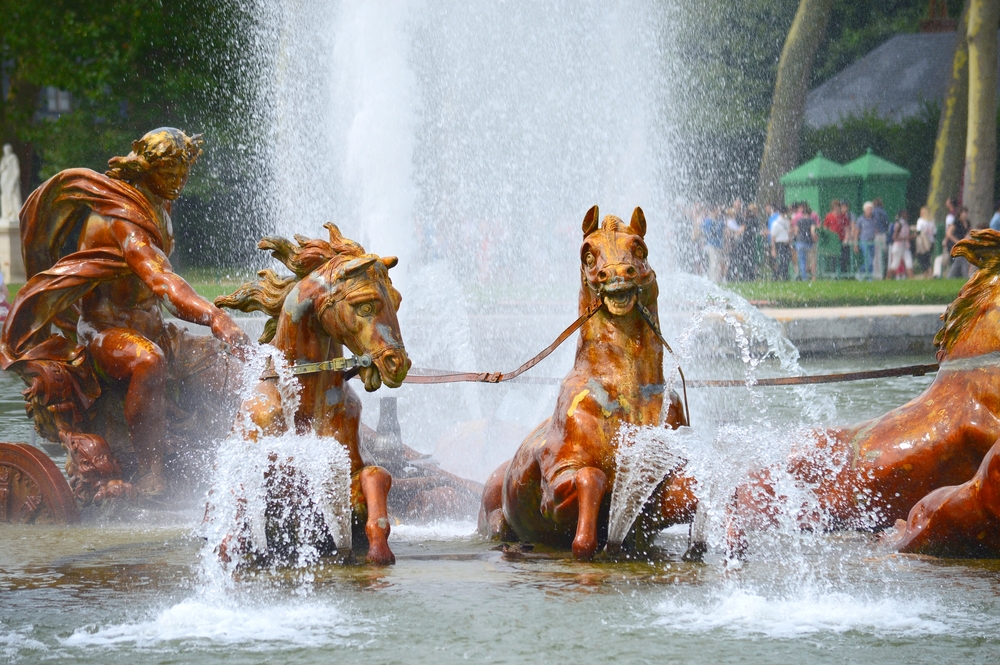
A series of gardens, created in a formal style, stood to the west of the palace (one of them today is in the shape of a star) and contained sculptures besides as the pressurized fountains capable of launching water loftier into the air. The formality and grandeur of the gardens symbolized Louis XIV's absolute power, fifty-fifty over nature, according to Gudek Snajder.
"From the outset Louis attached a supreme importance to these water effects. Their virtuosity formed the star plough of a tour of the gardens," writes Tony Spawforth, a professor at Newcastle Academy, in his book "Versailles: A Biography of a Palace" (St. Martin's Press, 2008). "The effects were the work of engineers whose machines made Versailles a hydraulic every bit much as an artistic wonder." Unfortunately, Spawforth notes, problems supplying water meant that the fountains could only be turned on during special occasions.
In addition a grand canal, constructed to the due west of the garden and running nearly a mile long, was used for naval demonstrations and had gondolas, donated by the Republic of Venice, steered past gondoliers.
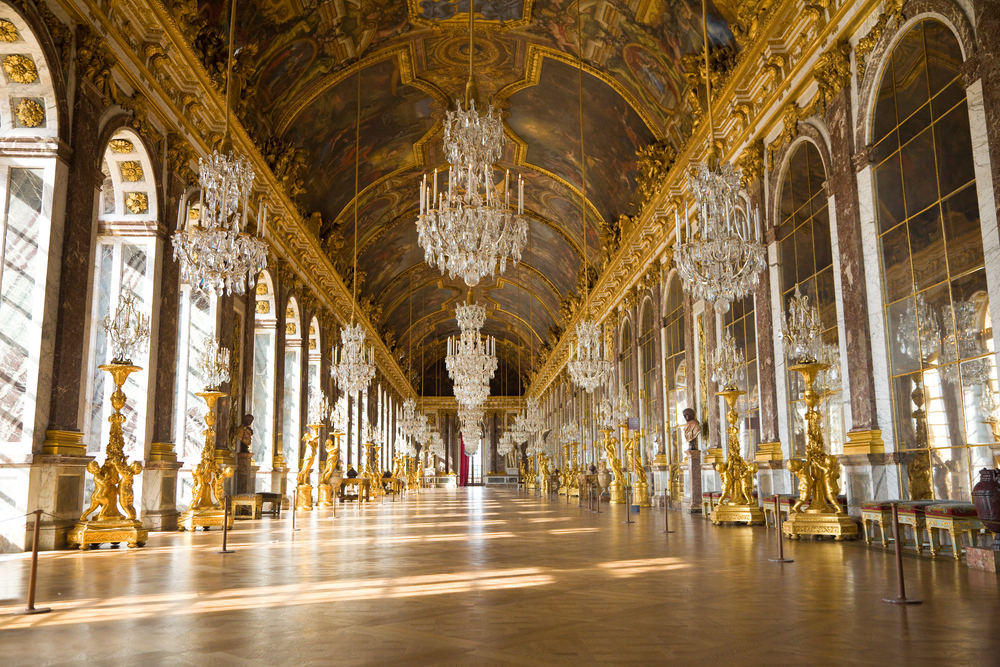
Building such a lavish complex was an of import part of Louis XIV's style of rule and beliefs nigh monarchy, which we would call absolutism, said Schmidt. "As king of France he was the embodiment of France — and his palace was meant to display the wealth and power of his nation," she said. "Furthermore, it was vital to him to raise France'southward status in Europe; not just past military machine feats only in the arts as well. For example, when the Hall of Mirrors was built, mirrors were ordinarily imported from Italy at a great price. Louis 14 wanted to show that France could produce mirrors just as fine as those produced in Italy, and consequently, all the mirrors of that hall were made on French soil."
Louis also insisted on moving the French government to Versailles. Scholars have suggested a number of factors that led him to build a great palace complex at Versailles and move the French government in that location. It's been noted that by keeping the king'southward residence some distance from Paris, information technology offered him protection from whatever civil unrest going on in the city. Information technology also forced the nobles to travel to Versailles and seek lodging in the palace, something that impeded their power to build up regional power bases that could potentially challenge the male monarch.
Equally the French government moved into Versailles, and the king plant himself swamped by work in his palace, he congenital himself the K (too called Marble) Trianon, a more modest palatial structure, virtually a mile (1.6 kilometers) to the northwest of the palace every bit a private retreat where merely he and those invited could visit.
Inside the palace
Spawforth notes that the palace contained about 350 living units varying in size, from multi-room apartments to spaces about the size of an alcove. The size and location of the room a person got depended on their rank and standing with the male monarch. While the crown prince (known as the dauphin) got a sprawling apartment on the ground floor, a servant may accept nothing more than a infinite in an attic or a makeshift room behind a staircase.
Louis XIV's sleeping accommodation was built on the upper flooring and located centrally along the due east-west axis of the palace. It was the most important room and was the location of 2 of import ceremonies where the rex would wake up (lever) and go to sleep (coucher) surrounded past his courtiers. The king also had a ceremony for putting on and taking off his hunting boots.
These practices were symbols of Louis XIV'south moniker of Sun King. "His courtroom was seen as microcosms of the universe and the king is the sun that shines over everything. Each activity he would took (having a meal, strolling through the garden) became symbolic metaphor for his divine presence," explained Gudek Snajdar. "The 'Escalier des Ambassadeurs' was the first and the about important Baroque ceremonial staircase. The interaction between the company and the king could be directed here in the most careful mode."
The importance of the courtiers' presence at these ceremonies continued into the reigns of Louis Fifteen and XVI. Spawforth notes that a courtier in 1784 wrote that "most of the people who come up to the courtroom are persuaded that, to make their mode there, they must show themselves everywhere, be absent as lilliputian possible at the king'southward lever, removal of the boots, and coucher, testify themselves assiduously at the dinners of the purple family ... in short, must ceaselessly work at having themselves noticed."
The king had his throne in the "Apollo Salon" and worshiped in a royal chapel, which spanned ii stories, which Bajou notes was built between 1699 and 1710.
Despite the richness of the palace, the kings had to make do with makeshift theaters up until 1768 when Louis XV allowed the building of the regal opera. Information technology contained a mechanism that allowed the orchestra level to be raised to the stage allowing it to be used for dancing and banqueting. Spawforth notes that the opera required 3,000 candles to exist burned for opening nighttime and was rarely used due to its price and the poor shape of French republic'southward finances.
Art and architecture
According to Schmidt, to our modern eyes, Versailles is a perfect case of baroque and rococo architecture. Simply, said Gudek Snajdar, the French of the fourth dimension would not have considered information technology baroque. "And it's understandable why," she said. "It's very different from, for example, Italian baroque architecture, which served equally an inspiration for other European countries during that time."
Having his palace evoke Italian bizarre architecture would have angered Louis Xiv. It would take gone confronting his sense of absolutism, said Gudek Snajdar, the belief that he is at the middle of everything. In fact, Louis XIV fired a famous Italian builder hired to work on the Louvre Palace, which was built not long before Versailles.
Some art historians now call the manner of the Louvre and Versailles "French classicism." They possess somewhat different features than Italian baroque architecture, including the emphasis on symbols of power and timeless domination. Other types of baroque architecture featured symbolic art, but non necessarily with the emphasis on divine right, kingly power and timeless rule.
"Everything in the Versailles of Louis XIV had a symbolic meaning," said Schmidt. "The ceilings are adorned with illustrations of Roman gods with Louis XIV himself painted every bit Apollo, the Sun God. Throughout the palace you will find the intertwined L's of his name. It all serves every bit a constant reminder that he is the rex and all power comes from him past the grace of God."
The ornamentation as well emphasized the achievements of the rex. "The 'Hall of Mirrors' and the adjacent Salons of State of war and Peace were decorated with the history of the male monarch," said Gudek Snajdar. The Hall of Mirrors has 30 tableaux that depict an epic story of Louis 14's achievements and aspirations. Victory in battle features prominently in these narratives, with i example showing Louis with his ground forces crossing the Rhine River in 1672. He is dressed in Roman clothes, his long pilus flows behind him, and he holds a thunderbolt like a projectile. He sits similar a god in a chariot that is being pushed by none other than Hercules himself.
Estate of Marie Antoinette
Virtually the Grand Trianon, Marie Antoinette, the queen of Louis XVI, created an estate for herself. She took over a building called the "Petit Trianon" and built a number of structures, including a working farm (also called the "hamlet"), which provided the palace with fresh produce, and a nearby business firm and small theater.
She too congenital a "Temple of Love," which modern-day curators say can be seen from her room in the Petit Trianon. Information technology features a dome propped upwardly by virtually a dozen columns covering a statue, which shows a delineation of "Cupid cutting his bow from the social club of Hercules," Bajou writes.
Additionally, she built the mannerly "grotto," a cavern that had a moss bed for Marie Antoinette to lie on. Information technology had two entrances, prompting much speculation as to what went on in it.
Though Marie Antoinette is known for her lavishness, in reality she did non e'er enjoy being queen. Her estate reflects a desire for a simpler life and homesickness for her native Austria. "Marie Antoinette grew up in Vienna as the youngest daughter of Empress Maria Theresa and Francis I. In the Habsburg Empire, royalty was allotted a far greater sense of privacy and she had a remarkably "normal" upbringing," explained Schmidt. "During her childhood she would enjoy private family dinners and played with commoners' children, but at Versailles that was impossible. One time she had get Dauphine, her life was constantly in the spotlight. Etiquette demanded that she dine earlier a seemingly never-ending crowd of spectators and getting dressed was a court ceremony in itself."
Marie Antoinette attempted to break some etiquette rules but was opposed by the court and the French people. She built the Hamlet and took over the Petit Trianon so that she could escape the many watchful optics and be herself. It was an attempt to "recreate some of her dearly missed babyhood."
American history at Versailles
Two key events in the American Revolution happened at Versailles. Benjamin Franklin, acting on behalf of a newly independent United states of america, negotiated a treaty with Louis 16, which led to America getting critical support from the French military. Spawforth notes that Louis XVI would have ane of his inventions, a "Franklin chimney," installed that produced less smoke than an ordinary fireplace.
Fittingly, the Treaty of Paris, which formally concluded the Revolutionary War, was signed on Sept. iii, 1783, at Versailles, close to the palace in the nearby foreign affairs building. Several decades after, when King Louis Philippe (reign 1830-1848) was turning Versailles into a museum, he would include a painting that depicts the siege of Yorktown, a decisive victory in the Revolutionary War in which the Americans and French cooperated against the British.
America would reciprocate in the 1920s when oil millionaire John D. Rockefeller Jr. paid to take the palace's expansive roof restored, amongst other buildings.
Versailles later the autumn
After the outbreak of the French Revolution in 1789, King Louis XVI and Queen Marie Antoinette would be stripped of power, brought to Paris and ultimately beheaded. The palace fell under the control of the new republican authorities.
Many of its furnishings were sold to help pay for the subsequent Revolutionary Wars. When Napoleon came to power, he had an apartment created for himself in the Grand Trianon, complete with a map room.
King Louis Philippe, in the museum he created, showcased different aspects of French history. The Battles Gallery tin all the same exist seen today with its modernistic-twenty-four hours keepers noting that the gallery'due south art depicts every principal French boxing between the Battle of Tolbiac in A.D. 496 and the Battle of Wagram in 1809.
In the late 19th and 20th centuries, Versailles curators would convert many of the museum areas back into palace space, trying to show how they looked before the French Revolution.
Two more pivotal events would occur at Versailles in this mail-revolutionary flow. In 1871, later on French republic had lost a state of war against Prussia, Kaiser Wilhelm I was proclaimed Emperor of Federal republic of germany in the Hall of Mirrors, adding an extra layer of humiliation to the French defeat. For several years afterward this defeat, the situation in France was and then bad that its Bedroom of Deputies and Senate opted to meet at Versailles, rather than Paris, for reasons of safety.
In 1919, France would take its revenge, of sorts, when the Treaty of Versailles, which imposed reparations on Germany, was signed in the same hall. Although the treaty formally ended World War I, information technology has been argued past some that it helped pave the style for World War II. Even and then, centuries subsequently its pocket-size start every bit a hunting club, events nonetheless took place at Versailles that ultimately helped shaped the earth we live in today.
Legacy
Today, Versailles is ane of the nearly-visited sites in France. Visitors are fatigued to its architectural grandeur, the stunning water features (concerts are oft played in the gardens during the summer) and its sense of history.
Every bit a symbol, Versailles can be understood equally i of opposites, said Schmidt. It reflects both the beauty and culture of France and its tumultuous history. "When it was built, it was a marvel (and still is) and represented French republic's power. However, toward the terminate of the 18th century information technology became more of a symbol of the aristocracy'southward wealth, which stood in stark dissimilarity to that of the mutual people. The unabridged mindset of order had changed with the Enlightenment, which caused the palace to exist seen equally a symbol of the old regime."
Source: https://www.livescience.com/38903-palace-of-versailles-facts-history.html
0 Response to "what event was the palace of versailless hall of mirrors designed to celebrate?"
Post a Comment